
Are Babies Meant to Be Independent? What's Actually Normal in the First Year
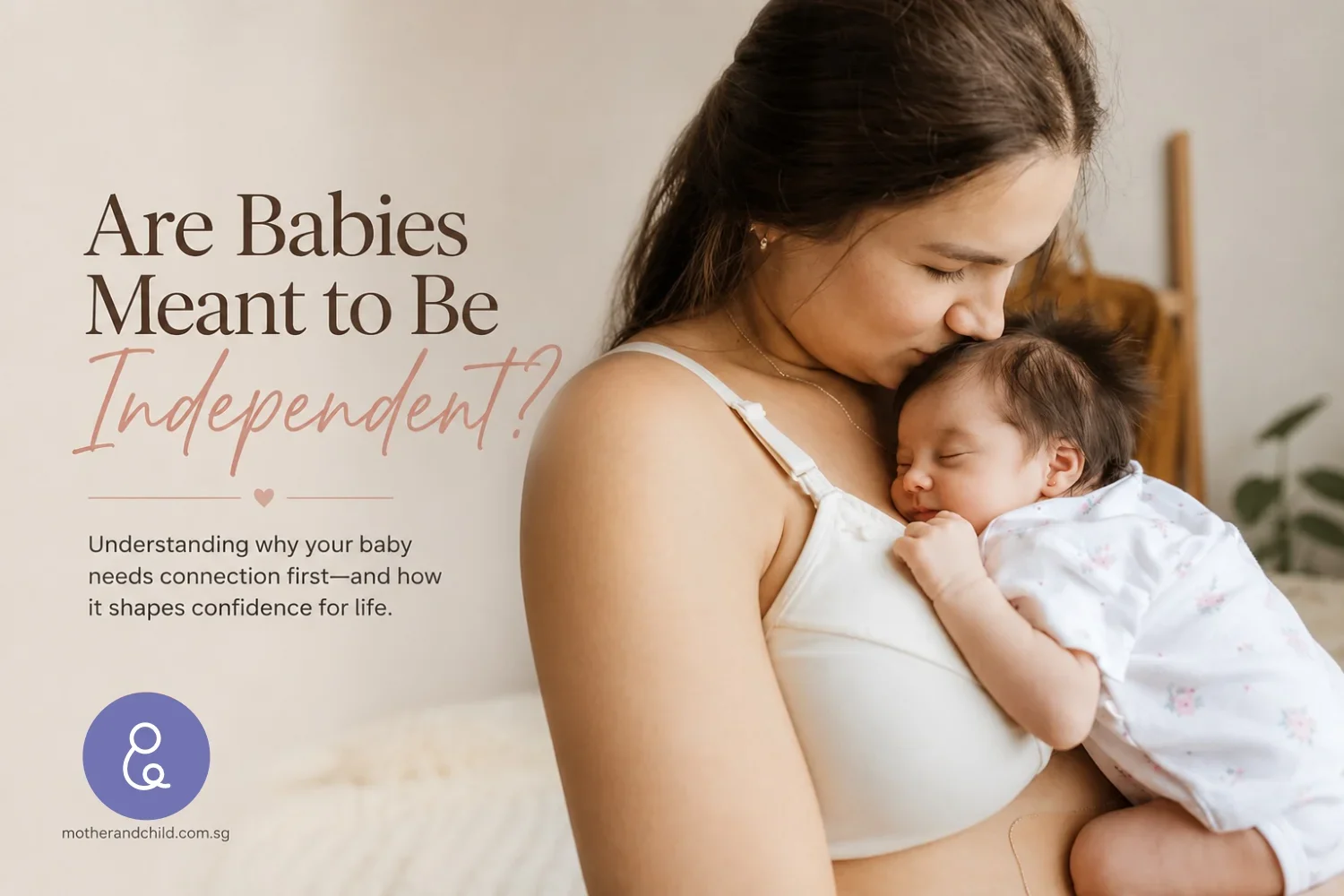
Written by Dr Mythili Pandi | Family Physician & IBCLC
Short answer: no — babies are biologically wired to be dependent, and that dependence is a feature, not a flaw. Human infants are born neurologically immature and regulate through closeness, touch, movement and responsive care. Wanting to be held, waking often and needing comfort are normal newborn behaviours, not habits to break early.
If you've ever wondered whether your baby is "too attached," or felt you should be teaching independence sooner, this one's for you.
The independence questions every new parent hears
Sometimes within days of bringing a baby home, many parents start hearing a familiar set of questions:
"Is the baby sleeping through yet?"
"Can they self-soothe?"
"Aren't you worried they're too attached?"
"Can you put them down awake?"
"Are they on a schedule yet?"
Underneath these questions sits a quiet assumption: that dependence is something a baby should outgrow as quickly as possible. We tend to celebrate babies who adapt fast to adult life — who slot neatly into routines, sleep on their own, and don't seem to need "too much."
But that assumption runs against what we actually know about how babies are built.
Why babies are wired for dependence
Compared with many other mammals, human babies are born remarkably early in their development. A foal can stand within hours of birth; a human newborn can't yet regulate its own temperature, emotions or stress levels without help.
This is where the idea of the fourth trimester comes in — roughly the first three months of life, when a baby is still adjusting to the world outside the womb. During this period and well beyond it, babies rely on the adults around them to co-regulate. Co-regulation is the process of a baby borrowing calm from a caregiver's heartbeat, voice, warmth and touch because their own nervous system is still developing.
In other words, closeness isn't a bad habit your baby has picked up. It's how their biology is designed to work.
What "normal" baby behaviour actually looks like
Much of what modern parenting culture frames as a problem is simply a baby behaving like a baby:
Wanting closeness is not manipulation. A young baby doesn't have the cognitive ability to "play" you. Seeking contact is a survival instinct, not a strategy.
Frequent waking is not always dysfunction. Light, frequent sleep is biologically normal in infancy and serves real purposes, including feeding and development.
Needing comfort is not bad behaviour. Comfort is a need, not a want — and meeting it helps build the secure foundation babies grow from.
None of this means parenting is easy. It means a lot of the behaviour parents are told to "fix" was never broken to begin with.
When parenting starts to feel like performance management
Alongside these expectations, parents today are asked to optimise almost everything: sleep, feeding, developmental milestones, routines. There's an app, a metric or a method for nearly all of it.
At some point, parenthood can start to feel less like a relationship and more like performance management — a list of targets to hit, with a baby's "independence" as the scoreboard.
It's worth asking whether this obsession with independence says more about the world we live in than about babies themselves. In Singapore, where many parents return to work after a short leave and share caregiving across helpers and grandparents, the pressure to get a baby "sorted" early can be intense. Often the real issue isn't the baby's behaviour at all — it's that modern parents are being asked to handle completely normal infant needs with far too little support.
The reframe that changes everything
At Mother & Child, we spend a lot of time reminding parents of one simple idea: biology is not a flaw.
Understanding what's normal rarely makes the hard parts disappear. The night wakings still happen. The contact naps still happen. But something important shifts: parents stop feeling like they're failing every time their baby behaves like a baby.
That move — from "What am I doing wrong?" to "This is normal, and I have support" — often changes the entire parenting experience.
You don't have to figure out the early months alone
Mother & Child has supported Singapore families since 1994. If the first weeks feel overwhelming, these are good places to start:
Childbirth preparation and HypnoBirthing — feel calm and ready going in.
Lactation and breastfeeding support — practical help from experienced consultants.
Postnatal and newborn care guidance — steady hands for those early, foggy weeks.
If your baby's behaviour is worrying you — or you'd simply like reassurance from someone who has seen it all — reach out. Sometimes understanding what's normal is the most powerful support of all.
What are your thoughts on this? We'd love to hear from you.
Frequently asked questions
-
No. Human babies are born neurologically immature and are biologically designed to depend on caregivers for regulation, comfort and safety. Independence develops gradually over years — expecting it in infancy works against a baby's natural development.
-
Yes. Wanting closeness is a normal survival instinct, especially in the first few months. Being held helps a baby regulate stress and feel secure; it is not a sign that you've created a "bad habit."
-
Usually not. Frequent, light sleep is biologically normal for infants and supports feeding and development. If you have specific concerns about your baby's sleep, feeding or growth, it's best to speak with a healthcare professional.
-
Very young babies aren't neurologically able to soothe themselves the way adults can — they rely on co-regulation with a caregiver. Approaches to infant sleep vary widely between families, so choose what feels right for yours and seek professional guidance if you're unsure.
-
A baby who seeks closeness is showing healthy, expected attachment — not over-dependence. Secure early attachment is associated with confident independence later in childhood, not less of it.
-
The fourth trimester refers to roughly the first three months after birth, when a newborn is still adjusting to life outside the womb and needs a high level of closeness, comfort and responsive care.