
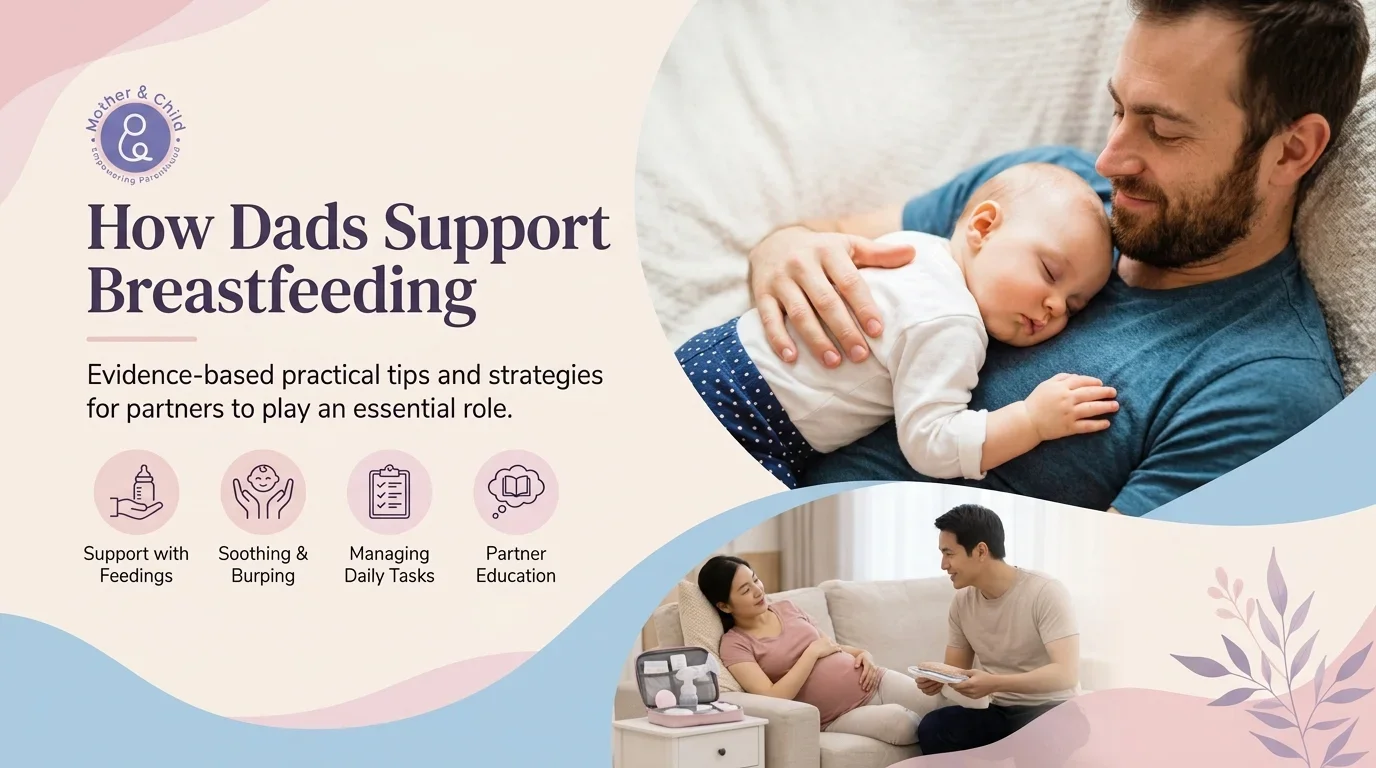
How Dads Support Breastfeeding — and Why It Matters More Than You Think
Dads aren't just there to "help" — a father's involvement is genuinely linked to more successful, longer breastfeeding. In the early weeks it's easy for a father to feel redundant: Mum is feeding, the baby seems permanently attached to her, so where does Dad fit in? As it turns out, quite a lot.
Here's what a father's real role looks like — and why it matters more than washing the pump parts.
"So where does Dad fit in?"
It's one of the most common feelings we hear from new fathers. In those early breastfeeding weeks, when so much revolves around Mum and baby, dads can quietly wonder whether there's a meaningful place for them at all.
There is. It just isn't always the obvious one.
What the research actually says
This isn't only sentiment — it shows up in the evidence. A 2026 study in the Journal of Human Lactation followed around 230 father–infant pairs and found that greater paternal involvement in breastfeeding was associated with exclusive breastfeeding at six months and a longer overall breastfeeding duration. Stronger father–infant attachment was independently associated with exclusive breastfeeding, too.
It sits within a wider and growing body of research: reviews and trials consistently link involving and educating fathers with better breastfeeding outcomes for the whole family. In other words, a supportive, informed partner genuinely moves the needle. (Link the study and reviews here.)
What paternal involvement actually looks like
What we love is how researchers describe that involvement. Not chores — five words:
Understanding. Help. Appreciation. Presence. Responsiveness.
That's far more meaningful than simply telling Dad to wash the pump parts. It means:
understanding what Mum is going through,
knowing a little about how breastfeeding actually works,
recognising when she needs food, sleep, reassurance — or professional breastfeeding help,
and protecting the space she needs to recover and feed her baby.
Supporting the dyad — without sitting on the sidelines
Supporting the mother–baby dyad doesn't mean Dad hovers at the edges. Alongside protecting that space, there's a whole relationship of his own to build:
Changing, bathing, settling, skin-to-skin, walking the floor at 3am, and gradually learning his baby's cues are all ways a father builds his own bond with his child. Feeding is Mum's domain in these early weeks — but the baby is both parents' to know and love.
Why we created Dad Skills
This is exactly why we created Dad Skills.
We don't want fathers leaving antenatal education thinking their job is simply to "help Mum." Dads aren't assistants. They're parents too — and they deserve to feel prepared for what comes next: to learn, ask questions, find their feet, and become confident in their own role.
Strong families learn together
Parenthood changes both of you. And while so much of our work naturally focuses on mothers and babies, we want fathers to feel there's a place for them here too.
Because strong families aren't built by one parent knowing everything. They're built by learning how to do this together.
Here's to raising confident mums, confident dads, and well-supported little humans. If you'd like to prepare together, you can find out more or book a session.
Frequently Asked Questions
-
By understanding what the mother is going through, learning how breastfeeding works, recognising when she needs food, rest, reassurance or professional help, and protecting the space and time she needs to feed and recover. Practical, informed presence matters more than doing feeding-related chores.
-
Research links greater paternal involvement with better breastfeeding outcomes — including exclusive breastfeeding at six months and longer overall duration — and studies that educate and involve fathers tend to see improved breastfeeding rates. A supportive, informed partner genuinely makes a difference.
-
Plenty. Beyond supporting the mother, a father can change, bathe, settle and carry the baby, do skin-to-skin, take night-time wakeful stretches, and learn his baby's cues — all of which build his own bond and lighten the load.
-
Bonding isn't only about feeding. Skin-to-skin contact, bathing, settling, carrying and simply spending responsive time with the baby all build a strong father–infant relationship, which research links to better outcomes for the whole family.
-
Dad Skills is Mother & Child's workshop for fathers, designed to help them feel prepared and confident — understanding breastfeeding and how to support it, caring for their baby, and finding their own role as a parent rather than just a helper.